Case Study: Turning Building Data Into Measurable Energy Savings
For building owners and facility teams, having more data does not necessarily lead to better building performance. The value comes from turning that data into clear, actionable information that helps operators identify problems, make improvements, and measure the results.
That principle is at the center of PointGuard’s approach: “Data should turn a wrench.” The PointGuard platform is built around speed to value, simple workflows, benchmarking and impact measurement, scalability, and flexibility.
A recent PointGuard case study demonstrates what that approach can look like in practice.
The Building The case study property is a five-story, 134,676-square-foot building that was approximately 22 years old at the time of the analysis. PointGuard was installed in November 2020 and operational by December 2020, with 2019 established as the baseline year for measuring changes in electricity costs.
Rather than simply providing another source of building data, PointGuard gave the facility team tools to translate information from the building’s systems into opportunities for operational improvement.
The Results: $25,000 in Annual Savings and 96% Fewer HVAC Complaints
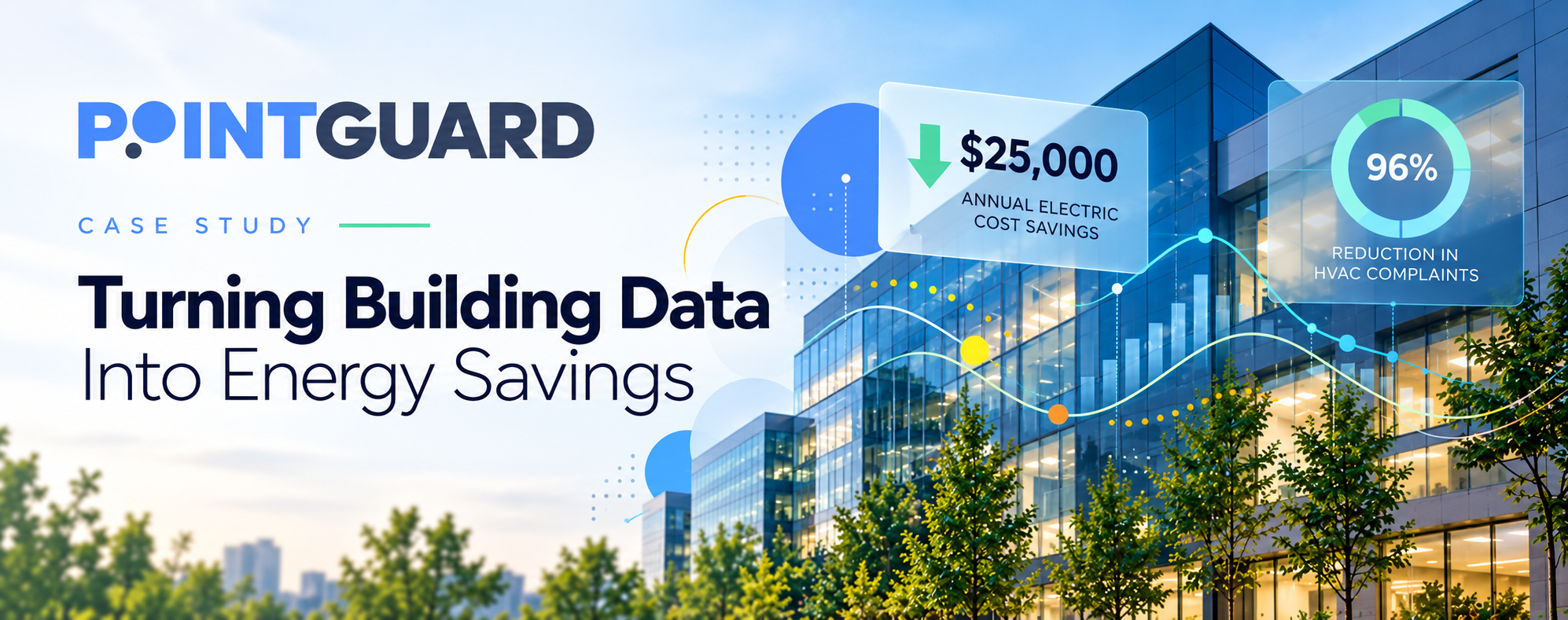
Since implementing PointGuard, the property has been able to maintain approximately $0.19 per square foot—or $25,000—in annual electric cost savings. At the same time, the building achieved a 96% reduction in tenant HVAC complaints.
The results demonstrate an important connection between energy efficiency and building operations: improving performance does not have to come at the expense of occupant experience. Better visibility into how HVAC and building systems are operating can help facility teams address inefficiencies while also identifying conditions that contribute to comfort problems.
Annual electric cost savings: $25,000 Electric savings: $0.19/SF Reduction in tenant HVAC complaints: 96%
From Building Data to Action PointGuard is designed to connect with most buildings that have a modern control system, including building management systems supporting the BACnet protocol and systems using a Niagara FrontEnd.
Once connected, the platform provides facility teams with several layers of tools for understanding and improving performance.
Performance tools include Performance Analysis, Fault Analysis, Potential Opportunities, VFD Meter Readings, and Rules Manager functionality. Quick tools help teams address specific operational issues through capabilities such as Setpoint Manager, Excessive Operations, Pressure Resets, Optimal Start/Stop, and identification of Simultaneous Heating & Cooling. PointGuard also provides tracking tools—including an Action Board, Project Manager, Audit Manager, Savings vs. Events Preview, Energy Insights, and Project ROI Baselines—that help connect identified opportunities with implementation and results.
Making Savings Visible Identifying an energy-saving measure is only part of the process. Building owners also need a way to understand whether improvements are producing meaningful results. PointGuard supports this through ongoing reporting, including monthly and portfolio-level performance and energy reports, CapEx reports, impact reports, and insights reports.
This combination of analysis, operational tools, tracking, and reporting creates a practical pathway from building data → identified opportunity → corrective action → measured impact.\
Building Performance Is an Ongoing Process PointGuard’s approach does not end when software is installed. Its Facility Profit Process incorporates onboarding, listening, tuning, training, and ongoing engagement, reflecting the reality that building optimization is a continuous process rather than a one-time exercise.
The results from this 134,676-square-foot property illustrate the potential impact: sustained annual electricity cost savings alongside a dramatic reduction in HVAC complaints.
For owners and operators managing individual buildings or portfolios, the lesson is straightforward: building data becomes valuable when facility teams can quickly understand it, act on it, and measure what changed.